
Z-Tomo Tomography
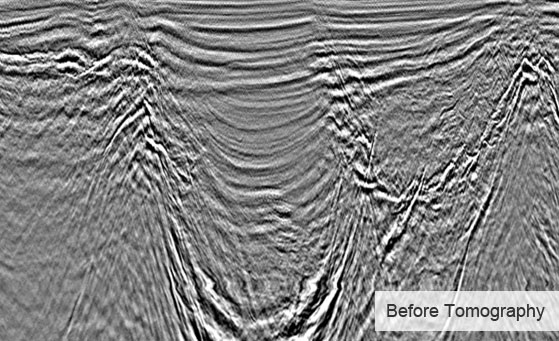
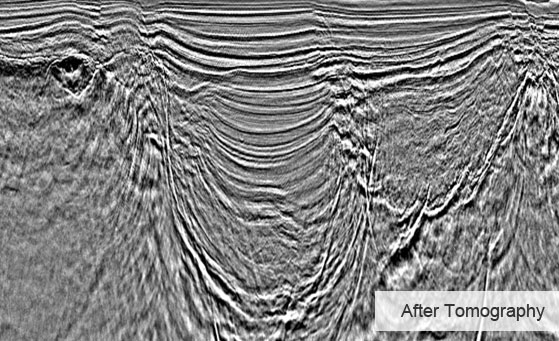
High quality imaging of subsurface structures requires an accurate velocity model. Migration Velocity Analysis (MVA) improves the velocity model associated with a survey in order to create an accurate image of subsurface structures. After seismic data has been migrated through its current interval velocity model, the consistency of the model with the data is assessed by examination of the moveout in the common image gathers (CIGs), which represents variation over different wave paths in the predicted depth of subsurface reflection events.
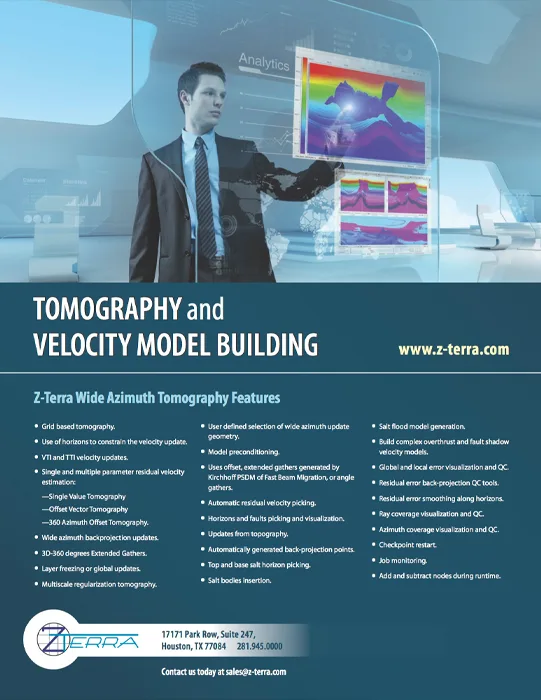
Z-Tomo produces high quality velocity models while dramatically reducing the time required for each iteration of tomography. It also supports a wide range of velocity model building options and workflows:
- Vertical and normal ray updates
- Deregowski loop updates
- Wide azimuth tomography using
- offset gathers produced by Kirchhoff or Fast Beam Migration (FBM)
- angle gathers produced by wave-equation migration
- angle gathers produced by Kirchhoff migration or FBM
- Residual move-out gather-flattening and gather-fitting techniques
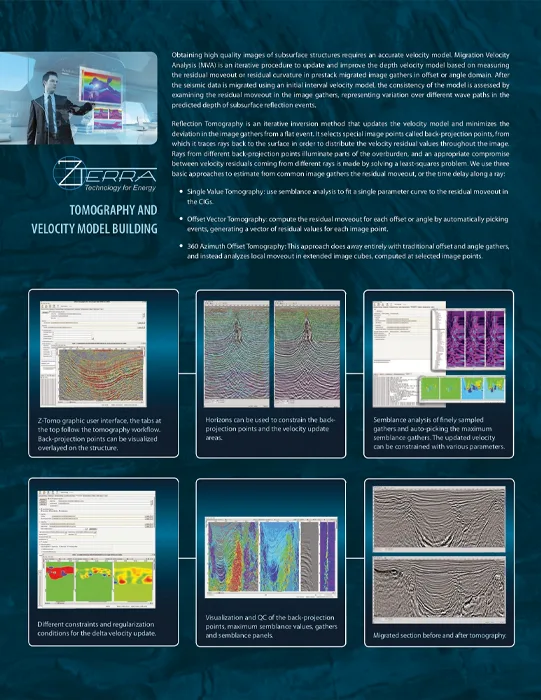
Reflection Tomography is an iterative inversion method that updates the velocity model and minimizes the deviation in the common image gathers from a flat event. It selects special image points called back-projection points, from which it traces rays back to the surface in order to distribute the velocity residual values throughout the image. Rays from different back-projection points illuminate parts of the overburden, and an appropriate compromise between velocity residuals coming from different rays is made by solving a least-squares problem. We use three basic approaches to estimate from common image gathers the residual moveout, or the time delay along a ray:
- Single Value Tomography uses semblance analysis to fit a hyperbolic curve to the residual moveout in the CIGs.
- Offset Vector Tomography computes the residual moveout for each offset or angle by automatically picking events, generating a vector of residual values for each image point.
- 360 Azimuth Offset Tomography does away entirely with traditional offset and angle gathers, and instead analyzes local moveout in extended image cubes, computed at selected image points.
Features and Benefits
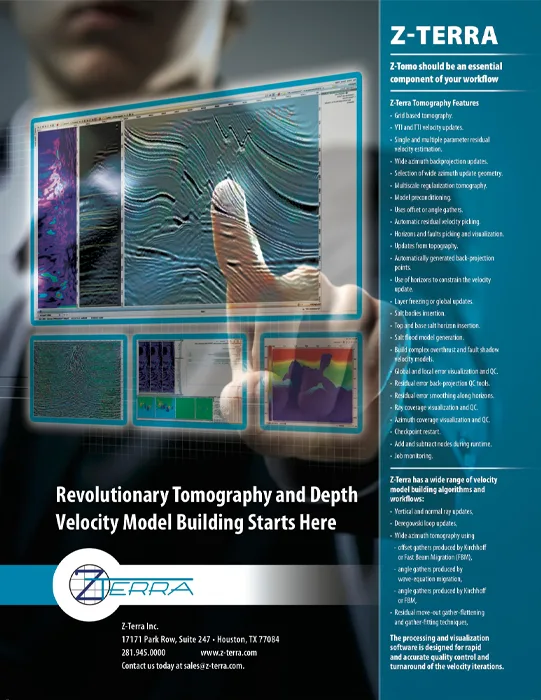
With its revolutionary tomography and depth velocity model building, Z-Tomo should be an essential component of your workflow.
The processing and visualization software is designed for rapid and accurate quality control and turnaround of the velocity update iterations.
Requirements