
Anisotropy Estimation
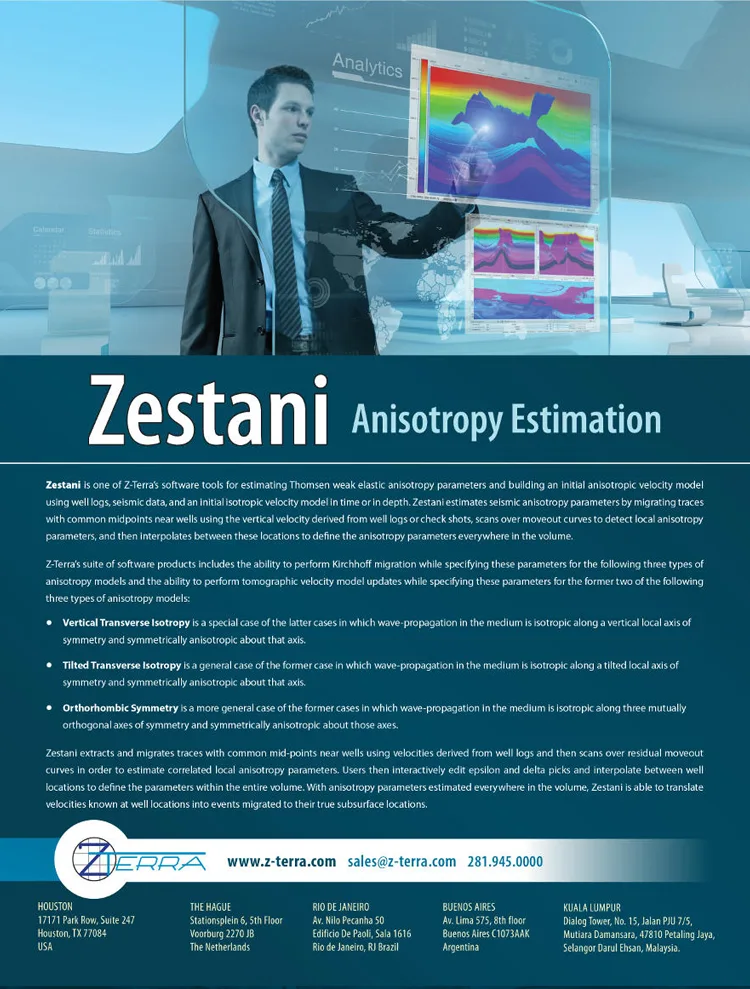
Zestani is one of Z-Terra’s software tools for estimating Thomsen weak elastic anisotropy parameters and building an initial anisotropic velocity model using well logs, seismic data, and an initial isotropic velocity model in time or in depth. Zestani estimates seismic anisotropy parameters by migrating traces with common midpoints near wells using the vertical velocity derived from well logs or check shots, scans over moveout curves to detect local anisotropy parameters, and then interpolates between these locations to define the anisotropy parameters everywhere in the volume.
Z-Terra’s suite of software products includes the ability to perform Kirchhoff migration while specifying these parameters for the following three types of anisotropy models and the ability to perform tomographic velocity model updates while specifying these parameters for the former two of the following three types of anisotropy models:
- Vertical Transverse Isotropy is a special case of the latter cases in which wave-propagation in the medium is isotropic along a vertical local axis of symmetry and symmetrically anisotropic about that axis.
- Tilted Transverse Isotropy is a general case of the former case in which wave-propagation in the medium is isotropic along a tilted local axis of symmetry and symmetrically anisotropic about that axis.
- Orthorhombic Symmetry is a more general case of the former cases in which wave-propagation in the medium is isotropic along three mutually orthogonal axes of symmetry and symmetrically anisotropic about those axes.
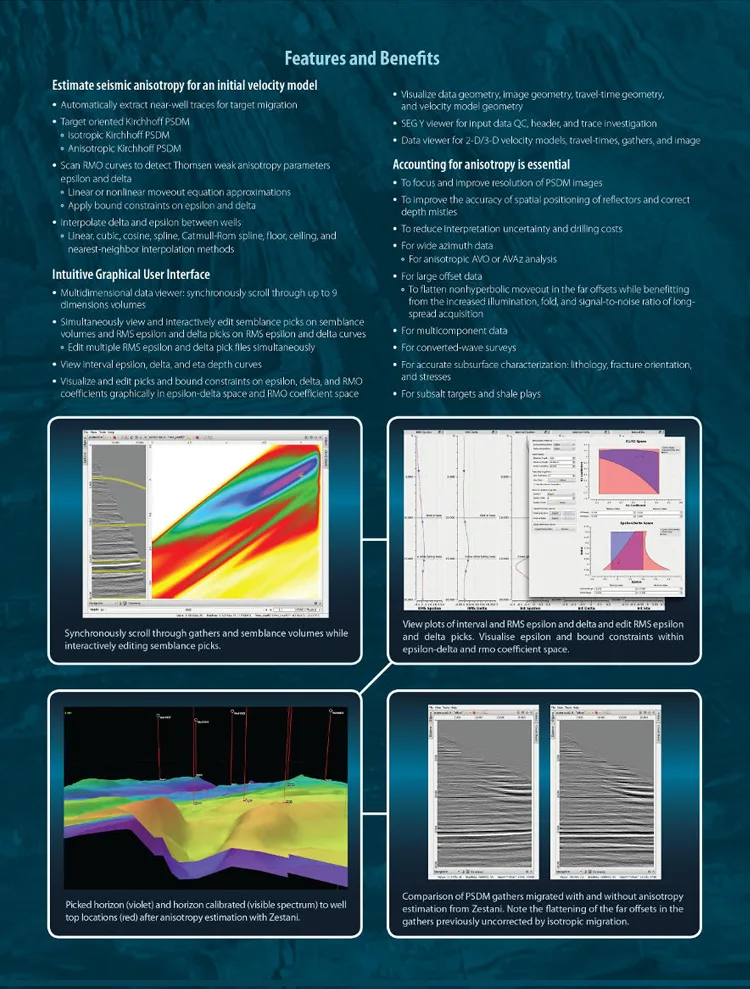
Zestani extracts and migrates traces with common mid-points near wells using velocities derived from well logs and then scans over residual moveout curves in order to estimate correlated local anisotropy parameters. Users then interactively edit epsilon and delta picks and interpolate between well locations to define the parameters within the entire volume. With anisotropy parameters estimated everywhere in the volume, Zestani is able to translate velocities known at well locations into events migrated to their true subsurface locations.
Features and Benefits
Estimate seismic anisotropy for an initial velocity model
Intuitive Graphical User Interface
Accounting for anisotropy is essential
Requirements